
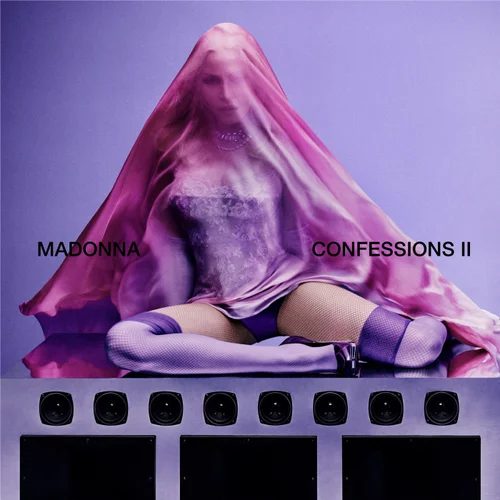
Twenty-one years after 'Confessions on a Dance Floor', Madonna walks back onto the dancefloor through the same door she left by: Stuart Price at the controls and an album built to be played front to back, like a set. 'I Feel So Free' opens at 155 BPM in A minor —a statement of intent that leans closer to trance than to the original's disco-house— and from there the journey settles into 'Good For The Soul' and 'One Step Away' before the first major stop: 'Bring Your Love', the single with Sabrina Carpenter.
Track five is the autobiographical heart of the trip. 'Danceteria' is named after the New York club where Madonna played her first live show in December 1982, back when she was still waiting tables there. And it's no loose wink: the album is partly visual, with a short film built around its first six songs, so the stretch from the opener to 'Read My Lips' with Feid plays like an origin movie with its star back home. Between the film block and the second act, 'Everything' works as the hinge.
From 'Love Sensation' to a family finale
The second half kicks off with 'Love Sensation', the other single, at 124 BPM in E minor —the pulse where Price is most at home— and allows itself its most electronic peak on 'Bizarre' with Martin Garrix. From there the album title turns literal: 'Fragile', 'My Sins Are My Savior' with Stromae and 'Betrayal' chain together the confessional stretch, and 'The Test' brings her eldest daughter Lola Leon into the studio. The closer, 'L.E.S. Girl', lasts just 2:50 —the shortest of the sixteen— and lands like a deliberate full stop, a nod back to the New York map where it all began. Released on Warner Records, with Martin Garrix, Cirkut and Andrew Watt also in the credits, some critics are already calling it her best album since the first 'Confessions'; heard in sequence, it's easy to see why.
Sources: Wikipedia · Rolling Stone · Official Charts · Vice